Showing posts with label Helena Bonham Carter. Show all posts

Friday, July 15, 2011

Harry Potter and the Deathly Hallows Part 2 ***


Director. David Yates
Cast: Daniel Radcliffe, Emma Watson, Rupert Grint
Ralph Fiennes, Julie Walters, Maggie Smith, John Hurt
Helena Bonham Carter, Michael Gambon, Alan Rickman,Clémence Poésy

Can mediocre literature make good cinema? This, and not how to kill Voldemort, has been the biggest mystery in the entire Harry Potter movie saga which began precisely a decade ago. Perhaps under precise hands even things as immaturely misguided as J.K. Rowling's bestsellers could achieve some sort of efficiency or even brilliance (Alfonso Cuarón's entry in the series is still the only one that came close to this) but most of the Potter films have reveled in big setpieces, lazy performances and too much information that might've worked in literature but feels muddled and conspicuous in cinema.
Take for example the horocruxes Harry (Radcliffe) has been searching for the last two films. In all honesty anyone could've told him about this since the beginning and get Voldemort done with. Why wait ten years to let him know how to destroy his biggest enemy? Raising values and teaching children how to find their true worth in the face of adversity by way of faceless demon creature? Maybe.
More cynical audience members might be willing to call it squeezing money out of your wallet though and they might be right. In all cases, these movies could've been retitled Harry Potter and the Efficiency of the Red Herring. The fact that this is the last film and therefore forces the director and writer to tie everything up gives it an urgency that the other movies never had. This is obviously evident in the huge dramatic punch the movie carries. There are farewells, deaths, shocking twists (Gambon's Dumbledore wasn't as nice as we thought and Rickman's Snape was!) and it all comes down to an anticlimactic showdown between the young wizard and Voldemort (Fiennes who will be remembered as one of the creepiest villains in film history).
For all its flaws the film results quite entertaining and after a tedious start picks up and delivers the goods at a brisk pace.
The children still are rather dull actors (except for Granger who oozes onscreen charm) but lukcy for them they are surrounded by astonishing actors. Smith gets more of a chance to shine this time around and in a fantastic fight scene, Walters goes all Lt. Ripley on the equally superb Bonham-Carter.
This time more than ever, the visual effects and production design seem to click and some scenes are completely spellbinding but perhaps most of the film's value is merely because it's the last one. As such it comes as a complex beast to evaluate in terms of purely adequate artistic value. The Potter films were never meditations on life and to come out of them with the desire to engage in Bergman-ian dialogues is out of the question, but they could've had a little something extra that went beyond the notions of just telling a story.
As exciting and harmlessly captivating as this installment is, leaving the theater you might notice you have already forgotten what the movie was all about.

Sunday, January 30, 2011

The King's Speech *½


Director: Tom Hooper
Cast: Colin Firth, Geoffrey Rush, Helena Bonham Carter
Guy Pearce, Eve Best, Michael Gambon, Timothy Spall
Jennifer Ehle, Claire Bloom, Derek Jacobi

It seems that for as long as there have been movies, that's how long their need to convince us they're just like us, has existed.
Why have most movies lost the need to revel in their own cinematic-ness? Why such a need to make us identify with them?
If you're looking for answers to those questions you might as well stay away from The King's Speech, a film so secure about its heart-tugging contrived maneuvers, that it dares to pretend it's a story about the every man when in fact it's a piece of ideological brainwash that reinforces the notion that the people watching it are precisely the exact opposite of what they're watching onscreen.
The film basically deals with King George VI's struggle with stuttering. We see him shame his father (Gambon), be bullied by his brother (Pearce), be nurtured by his wife (Carter) and eventually be cured by magical Australian Lionel Logue (Rush) before delivering the speech that, according to the movie, mattered more during WWII than the tons of lives lost afterwards.
The film is handsomely made but it's slightly offensive to think that more thought was put on the details in Helena Bonham Carter's hats, than in the way the film relishes in its somewhat fascist ideology.
With each new scene we see how more and more it's buying its own love for royalty and its seemingly "human" approach (awww it's tiny Queen Elizabeth!) is nothing more than a reaffirmation for the film's condescending look at the world that surrounds it.
As Hooper and company fail to find anything to question about the characters, these become puppets at the command of a modern fairy tale that pretends to exalt humanity when all it does is trivialize war in the face of royal adversity.
Sure, the king's achievement was notable and a triumph on its own, and sure, the fact that the people around him congratulate him on his success and seem to forget about the larger reality outside Buckingham Palace is quite normal, what's baffling is that the film fails to question these things.
It comes as no surprise that the film's best performance and its biggest asset comes in the shape of Eve Best as crown wrecker socialite Wallis Simpson; it's through her that we get the only glimpse of seeing what lied beyond the crown, beyond the obligations and especially beyond the facade.
If it wasn't for her we'd be stuck with a bunch of people who use their status as means to demean other- when Queen Elizabeth pokes fun at commoners who feel surprised to meet her, it's not really cute, it's disturbing- and as much as the film tries to make Lionel and the King achieve some sort of Becket like synergy, not such relationship is truly ever formed.
We are presented with a portrait of a group of gorgeously lit saints whose own personal troubles amounted to more drama than the Blitz and while some might get a kick out of watching the intimate lives of royals, their lives here are so restrained by public relations that this doesn't even serve as royalty porn, its purpose was never to allow us into their lives but to perpetuate the sort of ideology that can pass patronizing as back patting.
For a film that deals so much with communication, it's a shame that The King's Speech muffles the audience's voice so much.

Sunday, December 5, 2010

Harry Potter and the Deathly Hallows: Part I **


Director: David Yates
Cast: Daniel Radcliffe, Emma Watson, Rupert Grint, Ralph Fiennes
Helena Bonham Carter, Robbie Coltraine, Jim Broadbent
Michael Gambon, Brendan Gleeson, Rhys Ifans, John Hurt
Julie Walters, Imelda Staunton

Have you ever noticed how the trailers for the Harry Potter movies often make for much more exciting experiences than the films themselves?
Judging from what we were presented in the previews for this (the first part of two, in the series finale) this movie should've made us be on the edge all the time, gasping for air and having our jaws fall to the floor in amazement.
The truth is that the film feels like nothing else than a marketing ploy to extract every single penny from Potterites and those who accompany them to the cinema.
It's said that this film was meant to be as close to the book as it possibly could and perhaps that is why it fails to be engaging in a purely cinematic level.
The filmmakers seem to have forgotten that not everyone has read the books (or ever intends to) and besides recreating entire passages from J.K. Rowling's prose, they should also be creating something worthy of being transferred to the silver screen. Something that will feel magical for everyone who buys a ticket.
Instead we get almost three hours of Harry (Radcliffe), Ron (Grint) and Hermione (Watson) moping and setting up tents in lush forests where they hide from Lord Voldemort (Fiennes).
The kids are looking for the horcruxes they began looking for in the previous installment but now have to deal with the fact that the entire magical world is under Voldemort's rule.
Still there's not even a single moment when we feel these people are real and before you make some joke about Muggles keep in mind that these characters should be true to the world they inhabit.
This almost never happens, except of course with the mature actors but this movie belongs mostly to the children. Yates is often redundant (how many times can we see Ron feeling Potter envy in this series?) and while he concentrates on silly twists we never understand how is it that the kids have no protection against evil but still packed a different coat to wear during their escape.
The action sequences are limited and as usual character development is restricted to a few moments of big dialogues that often result more stilted than not (why are they wasting Carter's Bellatrix Lestrange so much? She has such potential!)
It's a shame that the film feels so stale when absolutely everything is so handsomely crafted. The cinematography by Eduardo Serra evokes ancient carvings and even when he tries too hard to emulate Andrew Lesnie's magnificent work in The Lord of the Rings trilogy and Alexandre Desplat provides a sumptuous score that perfectly works with John Williams' already iconic theme.
When you come to think about it, this movie might be the exact opposite of The Two Towers, an introspective chapter that serves mostly to link plot turns. While Peter Jackson's movie managed to make the film a stand alone piece upon itself, Yates makes this Potter feel like waste the movie's almost three hours long and we find out what the deathly hallows are during the last fifteen! He even includes his own Gollum in the shape of Dobby (and sometimes even Ron) but fails to make any sort of emotional connection between what we're seeing and what we're supposed to be feeling.
Speaking in simple literary terms Harry Potter and the Deathly Hallows: Part I is a luxurious hardcover version of a silly airport novel.

Saturday, December 4, 2010

Sheet-y Saturday.

Where we take a look at posters for upcoming features.


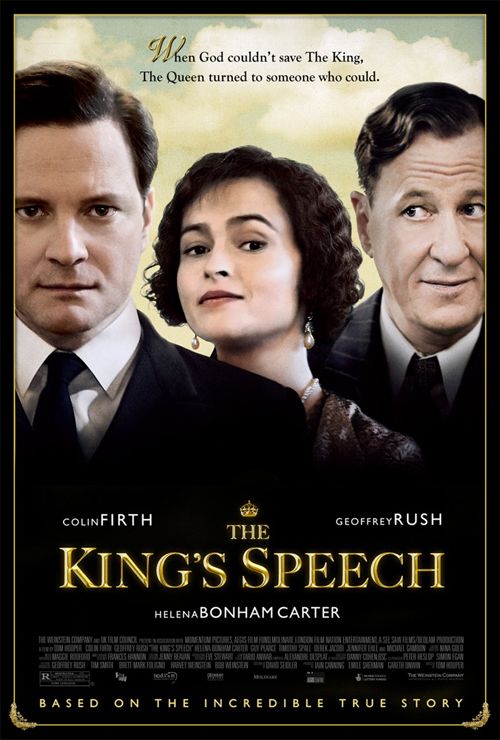
After the truly hideous design the marketing team over at the Weinstein Co. had made for The King's Speech, it's refreshing to see they finally came up with something that's not only lovely but also brilliantly executed.
Colin Firth's lips look thinner than usual and very well represent the dilemma at the center of the plot, notice how the microphone coming from above actually seems to evoke something godly and how the entire thing is a version of Michelangelo's famous painting of God and Adam atop the Sistine Chapel.
I'm thinking that the Weisnteins redid their campaign because they must know what ugly posters can do to Oscar movies...


I have to confess when it comes to documentaries I'm the most unversed person alive. All I know is Michael Moore, some Errol Morris, Herzog (LOVE his docs!) and a slew of the preachy stuff that always win Oscars.
However I have never seen what some think of as the greatest documentary ever made: Shoah.
When it comes to it I tend to think like Annie Hall "four hours of suffering!" but seeing how it's getting a new release I'm wondering if I've truly been missing out on something great?
Have you all seen it, should I stop being lazy and rent it?

Also, kudos to my friend Andrew for spotting this.
He gets the honorary Sheet-y Saturday badge of honor.

Wednesday, April 7, 2010

Alice in Wonderland ***


Director: Tim Burton
Cast: Mia Wasikowska, Johnny Depp, Helena Bonham Carter,
Anne Hathaway, Crispin Glover, Matt Lucas, Stephen Fry
Michael Sheen, Alan Rickman, Marton Csokas, Timothy Spall

Lewis Carroll's books of Alice in Wonderland have been adapted into movie form since the medium began. From silent versions to the subversive animation of 1950's Disney to Jan Svankmajer; Alice's story has always fascinated artists who tend to explore the horror that lies in the innocent.
It makes sense that Tim Burton would want to do his own version, and even if it's not the definitive take fans of the filmmaker were expecting it to be, it's a lovely ride and one of Burton's most mature films to date.
Taking Carroll's text for a spin, he makes Alice (Wasikowska) a nineteen year old girl about to be married to a man she barely knows.
Encouraged by her deceased father (Csokas) to use her imagination and spoiled by the dreams she's had all her life about strange characters and a mysterious land, she follows a white rabbit (voiced by Sheen) on the day of her engagement.
She falls inside an all too familiar hole in the ground where she finds the door to Underland, a place populated by weird characters who insist she's come to fulfill a prophecy.
Soon she learns that not only she has been there before (creating an interest dilemma between what reality is in dreams while giving Disney the opportunity to make endless sequels relying on this concept) but this time in particular she's set to end the reign of the evil Red Queen (Carter) and hand the crown to her sister the benevolent White Queen (Hathaway).
Alice teams up with Tweedledee and Tweedledum (Lucas), the Cheshire cat (Fry), the blue caterpillar Ebsolem (Rickman) and the Mad Hatter (Depp), among more famous characters, as she explores this wonderland and learns lessons for her own life.
Obviously stuck somewhere between the director's vision and the studio's demands Alice in Wonderland is uneven in narrative terms as it struggles between the edge of Burton and Carroll, with the status quo preserving by way of forced naivete Disney specializes in (it's surprising but the animated version is much darker than this).
Therefore we see how Burton inserts his dark humor and macabre nature by way of the art direction, concealed symbols and unexpected character quirks.
In this way Hathaway's, Nigela Lawson-inspired, White Queen takes an aim at social terms of perfection with a lunatic side (watch as the actress deliciously travels from Barbie to Chucky in seconds), Carter indulges in the oddity of her character's construction (her giant head and blood red lips are almost iconic), while Depp surprisingly underacts his way out of the Hatter's madness, creating a character that moves more than it disturbs (his character's post traumatic stress disorder might be a bit too facile but also allows Burton to take a subtle aim at the effects of war).
Perhaps it served Burton to tone down his darkness because the film achieves a calm and sense of equilibrium that allows both opposing visions to co-exist and deliver entertainment that's clever and simple.
In many ways the film is more shaped after The Wizard of Oz than any previous incarnation of the Alice story and in the same way frames the protagonist's adventure against unconscious manifestations.
At first Burton stresses too much what "real life" character will inspire each Wonderland inhabitant but soon this becomes an opportunity to decipher if Burton finally found a way to comment on the power of dreams.
The fact that this Alice often wonders out loud if she's inside a dream doesn't make her smarter than Oz's Dorothy, but serves as a well meant, if underwritten, attempt to encompass female liberation and the Industrial Revolution overthrowing Victorianism.
For all the flaws in Alice in Wonderland we are rewarded with lush scenery, extremely thought out character design and a filmmaker surprisingly finding marvels under restraint.
Like his heroine, Burton enters a land that thrives with the promise of unknown terror but his ability to refresh his aesthetics despite compromise is the real wonder.

Saturday, July 25, 2009

Harry Potter and the Half-Blood Prince **


Director: David Yates
Cast: Daniel Radcliffe, Emma Watson, Rupert Grint
Michael Gambon, Jim Broadbent, Alan Rickman, Maggie Smith
Helena Bonham Carter, Robbie Coltrane, Tom Felton, Bonnie Wright

"Are you confused?" asks a concerned Albus Dumbledore (Gambon) to Harry Potter (Radcliffe) as they uncover yet another dark mystery halfway throughout the film. "I wouldn't be surprised if you were" he continues without waiting for Harry's reply.
Dumbledore, as it seems, may not only be speaking to Potter, but to an entire audience, who have never read J.K. Rowling's famous books and will have a hard time following, or even being interested, in a movie that contains as many plot holes, discrepancies, lack of character subtext and coherence as there are tastes in Bernie Bott's Every Flavor Beans.
Since there is no re-introduction needed the film throws us back into Hogwarts where Harry and his friends Ron Weasley (Grint) and Hermione Granger (Watson) return for another year of misadventures.
This time around Lord Voldemort's Death Eaters, who have seemingly recruited Draco Malfoy (Felton) as an inside agent, have been attacking the Muggle world and are, as usual, trying to infiltrate Hogwarts and help their master take over the world.
After almost reaching a decade of movies, the Harry Potter series has become formulaic and by now everyone knows that all of the films will at some point have all of the following: Christmas vacations, a Quidditch match, a sudden attack from Voldemort and a new professor in the school.
Said professor now comes in the shape of Horace Slughorn (Broadbent) who is reluctant to return to Hogwarts, but does so after insistence from Dumbledore.
Slughorn may possess valuable information about Tom Riddle (A.K.A Voldemort) which might help the good guys get rid of him before long.
Dumbledore of course recruits Potter to carry out this mission and most of the film consists of the execution of said plan.
The problem with such a thing is that the films have fallen also into a state of disconnect from any sort of "realism".
Why are we supposed to believe that things go wrong only when the kids are back in Hogwarts? Does evil also take a summer break? None of the films in the saga so far have been able to create believable links between each installment.
It's ironic when Professor Minerva McGonagall (Smith) tells Harry, Ron and Hermione "why is it that whenever something happens, you three are always involved?".
It's obvious that they're the stars, but it should be only obvious for the audience, not the characters themselves.
Most of the ensemble does a good work; people like Smith, Gambon, Carter (who is a wicked tease!) and Rickman can do no wrong (he is a particularly sinister scene stealer) and the delightful Broadbent brings freshness to what was feeling like a stale staff.
The kids on the other side are obviously still learning their craft. Most of the time they act like actors acting.
This problem is more obvious with Radcliffe, who movie after movie, manages to turn Potter into an uninterestingly smug kid playing humble and nice.
It comes as no wonder however that they act this way, when the film constantly neglects their "human" side. They are forced fed with dialogues and quips that have no verosimilitude and because of this the film loses its most important ally.
There are several subplots involving their sexual self awareness. Harry begins to fall for Ron's sister Ginny (Wright) while Hermione puts aside her pride and accepts that she might have feelings for Ron. They all of course spend most of the film denying such things and date other students to get over their actual feelings.
And it's not so surprising that these are the most involving scenes in the movie, where the kids get to act like kids and saving the world is something that comes second after finding who they really are.
The film is filled with sexual innuendos (that seem accidental) but actually make the whole thing feel alive for once. There is a particular Quidditch match where the position of Ron's broomstick only rises more as he becomes more satisfied.
But then the director comes and completely de-sexualizes the characters turning them into words straight out of a screenplay.
One, that isn't even that good to begin with. Writer Steve Kloves' delivers his most uneven script of the series yet. Many things in this installment seem incomplete; several key characters disappear for long periods of time and some are featured just for the sake of filling a billing.
Even if you haven't read the book it's easy to detect that a lot of material has been ignored because the plot advances in a bizarre way, it stalls more than it flows.
Fans of the book will probably dislike this feeling, but those who go to the theater expecting to see a movie will also have much to wish for.
Both Kloves and Yates seem to have forgotten that they are crafting a movie and unlike in literature there are things that can't be found by turning back a page at your desire.
"The Half-Blood Prince" feels more like a work in progress than an ultimate adaptation and very few scenes evoke a pinch of emotion out of the viewer.
It's a shame because with the magnificent work of the tech department (the costumes and art direction are stunning) the look of the saga has finally matured.
Particularly with the achievement of director of photography Bruno Delbonnel, who does actual magic with the light and his camera.
Several scenes in the film will take your breath away just from the sheer beauty they possess. Delbonnel transports his sunny French take into Hogwarts which is a more macabre environment.
His aesthetic sometimes recall nineteenth century fairy tale engravings which had both the mystery and the humanity that fascinated and attracted people so much to these stories.
Through his lens for the first time the things inside a "Potter" movie feel less like props and more like actual lived-in heirlooms.

Saturday, July 4, 2009

Terminator Salvation **


Director: McG
Cast: Christian Bale, Sam Worthington
Common, Anton Yelchin, Bryce Dallas Howard
Helena Bonham Carter, Jane Alezander

The fourth installment in the "Terminator" series begins in the year 2003 where Dr. Serena Kogan (Bonham Carter in full Burton, necrophylia mode) convinces death rown inmate Marcus Wright (Worthington) to donate his body to science. After this "random" prelude we flash forward to 2018 where Judgment Day has taken place and humans are living in hiding under the threat of Skynet and their terminators.
After a Resistance attack, Marcus Wright wakes up and finds himself with no memory of what happened to him after his death. He decides to find answer at Skynet.
John Connor (Bale) is now a leader of the Resistance planning a massive attack on Skynet enterprises. Little does he know that the company has a plan of its own and are trying to kill his yet-to-be father, the young Kyle Reese (Yelchin) who is unaware of being a target.
Before you can say Arnold Schwarzenegger their stories become intertwined and fans of the "Terminator" franchise will hopefully be thrilled to find out new links in the mythology they follow religiously.
For the rest of the audience the film will seem yet another mindless summer blockbuster and that is obviously its biggest flaw.
The characters' history is quite easy to follow, you just need to know "John Connor must die" and disengage all scientific notion of time travelling to get in the film's universe.
This however doesn't justify the fact that the movie feels mostly like a very long prequel to the upcoming sequels.
The film's very existence is impossible to justify as it doesn't add much to what should feel like a saga. You never really care for the characters because early on the filmmakers reassure us that life is expendable if you have time travel and evil machine corporations.
This leaves them time to fill two hours with explosions, all the kinds of robots they can invent (look it's a Motonator!) and references to the previous movies.
The ensemble is mostly uninterested and uninteresting; Bale loves his time in the spotlight and squeezes even the last tough scream and grunt he can get out of a single line of dialogue (is his character dislikable because of the arrogant incident between the actor and the film's cinematographer? It obviously adds a little something to those watching the film), Alexander is cast as one of those "wise and eccentric post apocalyptic priestesses" sci-fi has reserved for respected actresses, Yelchin lacks presence to feel as if his character is important and the underrated Howard is left as an accesory.
The film overall would be a complete miss if it wasn't for the electrifying Worthington who convinces you there is something meaningful going on, at least through his character's eyes.
He turns Marcus into a battlefield of emotions and after a twist (revealed in one of the trailers...) he finds the humanity nobody else in the film ever achieves.
Even when the plot gives him opportunity after opportunity to revel in grandiose moments deemed to be iconic for the franchise (the whole Jesus Christ metaphor is ridiculous and lacks subtlety...crucifixion motives, the whole resurrection issue, John Connor's initials and their connection in the end...) Worthington keeps it down to Earth and visceral. He is this sequel's salvation.

Sunday, February 10, 2008

Sweeney Todd: The Demon Barber of Fleet Street **

Director: Tim Burton
Cast: Johnny Depp, Helena Bonham Carter
Alan Rickman, Timothy Spall, Sacha Baron Cohen
Jamie Campbell Bower, Jayne Wisener, Ed Sanders

Based on Stephen Sondheim's beloved musical, Tim Burton does a great job adapting it into cinematic form, but in the process has lost some of the urgency and majesty of the source material.
Johnny Depp plays Benjamin Barker, a barber who is sent to prison by Judge Turpin (Rickman) so he can keep his wife and daughter.
Fifteen years later, Barker, who has now taken the name of Sweeney Todd, returns to London and sets shop above Mrs. Lovett's (Bonham Carter) pie store, where he begins to device his revenge.
But as Mrs. Lovett reminds him the best part about this would be to "plan the plan" and while Sweeney sharpens his knives (who he calls his friends), Mrs. Lovett finds herself content with the company of this man who she loves.
On the other side of town, a young sailor (Campbell Bower) has become infatuated with Johanna (Wisener), Sweeney's daughter who is being held captive by Judge Turpin. Luckily for Sweeney, he becomes involved in a plan to rescue her, but more than having his daughter back his mind is set in revenge and after a failed attempt to murder Judge Turpin, he decides that now he will take revenge on everyone.
Just like that and the film's flaws begin with this rushed decision; if it wasn't for the fact that the music becomes louder, Burton sets the visuals and Depp raises his voice we wouldn't know that a big twist has occurred.
More than character development, this event just pushes the plot forward, because soon Sweeney is slashing people's throats so that Mrs. Lovett can make pies out of the deceased.
Depp does fine work as Sweeney, but whoever thinks he is proving his versatility is blinded by the fact that now he sings. Someone should give the man a role that doesn't require for him to be covered in makeup and act weird.
His lackluster performance is the film's biggest detractor. Perhaps he shouldn't have been loud and morbid, but he is nothing. You can not detect a single emotion in Depp's Todd. And it wouldn't be fair to say that to be soul-less was the intention, because you should at least feel the rage that inspires his revenge and turns him mad.
The best thing in the film, along with the gothic visuals, might be Bonham Carter's performance.
You never know what on Earth this woman sees in Sweeney, but the actress, whose singing voice is a whispery tease, brings the only life the film has.
While she might seem like "The Corpse Bride" come to life, you miss her when she's not onscreen. Her scenes with little Toby (Sanders), who develops a protective crush on her, are the only times when the film achieves any evidence of real emotion.
As grotesque and morbid as it all may sound, the monochromatic color scheme, the dreariness of the settings and the overtly Tim Burton-ness of the film can't cover the dark satire contained in Sondheim's work.
When the film reaches its complex final twist, where there should be tears and gasps, you feel a void which is covered by buckets of fake blood that fill the spaces where emotions should've been.
It should feel appropriate that a film so filled with death had been extracted of all its life.
Somehow it just doesn't.
Related Posts Plugin for WordPress, Blogger...