Showing posts with label Manolo Cardona. Show all posts

Tuesday, March 22, 2011

(My) Best of 2010: Actor.

5. Mark Wahlberg in The Fighter

Wahlberg's performance in The Fighter is a knockout simply because it's not. While the actors and characters around him indulge in method acting and quirky, over the top, characterizations, he simply is.
Playing real life boxer Micky Ward, he seems to leave behind all traces of self importance and plays him like a man conflicted with the world around him. Doubting whether to stay true to family, duty or self, he subtly invades everyone's world as they try to invade his'.
Watch him in scenes with Christian Bale, during which he exudes fraternal love through tiny smiles and prideful eyes. Then watch him in scenes with Melissa Leo, who plays his mom, and observe how he disguises exasperation with obligation.
His scenes with Amy Adams are the real treat though; she plays his girlfriend and it's with her that we see him truly shine. An innocent hand grab becomes sublime support, a silence becomes an argument and a shrug opens up a world of painful possibilities, the likes of which he never exhibits in the ring. His performance proves that you don't have to wear your heart on your sleeve to show your humanity.

4. Manolo Cardona in Undertow

It must not be easy playing a symbol, and Manolo Cardona does it with such ease, that his performance becomes devastating and haunting.
As a gay artist in love with a sexually confused fisherman, he symbolizes art, homosexuality and unspeakable love, yet he never turns his character into a mere vessel.
He still plays him with the traits of a full rounded person and his eyes still look from the screen with pain and piercing desperation.
When the movie literally turns him into a symbol, he preserves this core and becomes an embodiment of memory and how its overreaching power can comfort or destroy us.
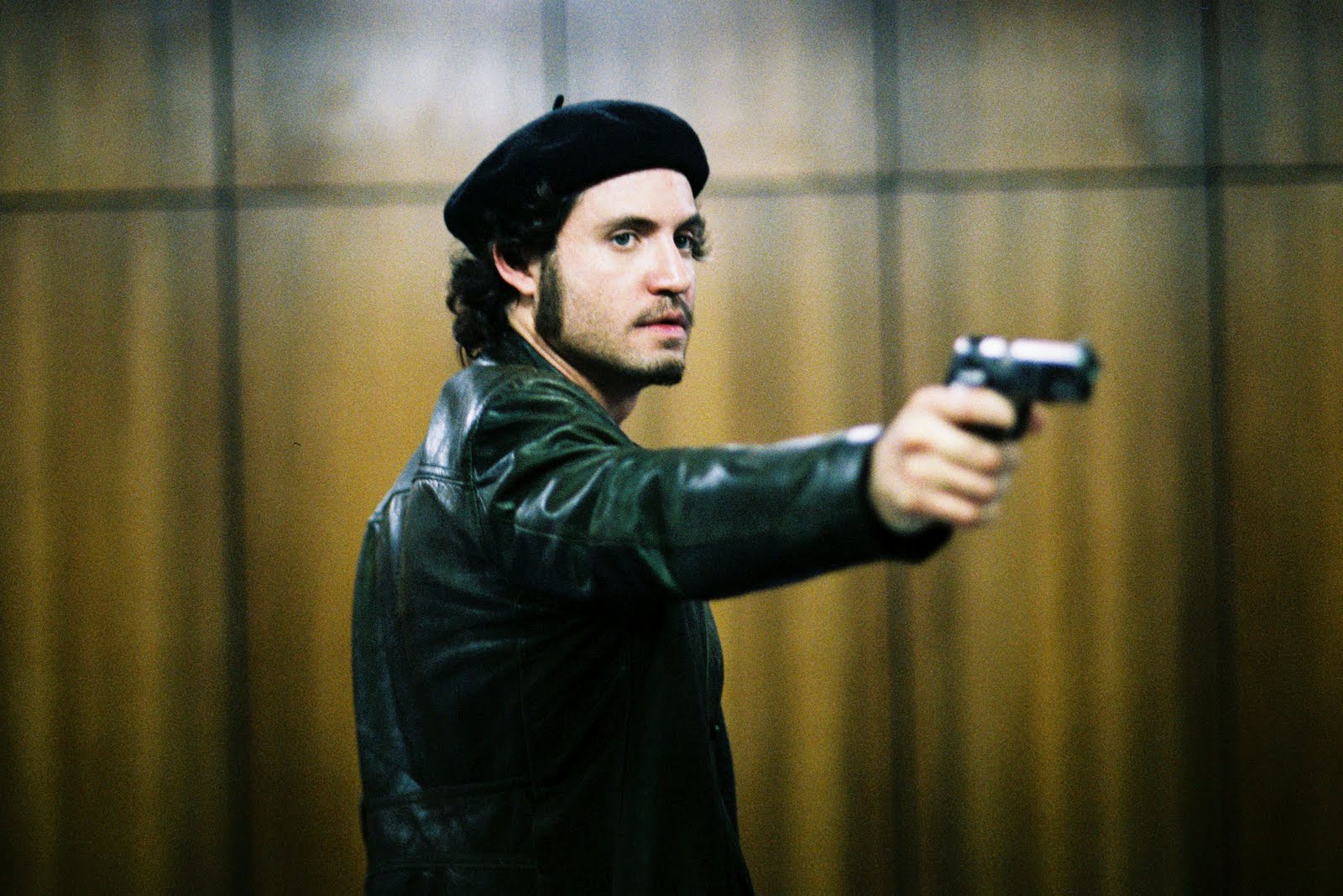
3. Edgar Ramírez in Carlos

Few actors are able to turn crime into charisma, yet Ramírez does it as famed terrorist Carlos "The Jackal". Watching him during almost six hours, he doesn't give a single false step and his performance eveolves with every passing minute of Olivier Assayas' astonishing accomplishment.
Watching him grow from a narcissist idealist into a damaged plastic surgery patient is nothing if not engaging. What's more, he changes his body with such deft unawareness (watch him go from sex symbol to chubby down on his luck criminal) that you never think twice about thinking that this man indeed aged the three decades we see him portray in the film.

2. Stephen Dorff in Somewhere

When you think "movie star", Stephen Dorff is probably not the first name that comes to mind. Yet, in Sofia Coppola's intimate Somewhere, he embodies the enigma of Depp, the effortless sexiness of Clooney and the troubled nature of James Dean, while providing him with a heartfelt sensitivity and grace.
It's easy to guess that the movies Johnny Marco does are the exact opposite of something Coppola would do (just take a look at the fiery posters featured in the film) but what Dorff proves to us is that you can't simply judge a book by its cover (or a film for its poster?).
Since Coppola gives us access to the most intimate moments in this man's life we see Johnny trying to find beauty and meaning in everything he does.
Dorff is able to overcome "poor little rich boy" clichés and delivers a sweet performance that defies our judgment. His best scene might be an awkwardly staged spectacle in which he's rewarded for his life achievements during an Italian awards show.
Watching him there paralyzed by the unknown (and giving us glimpses of subtle American xenophobia) yet thrilled by the presence of his daughter, we understand that once the movie's over we probably will never understand this man.


1. Jesse Eisenberg in The Social Network

No other actor, in no other 2010 movie, delivered his lines with the conviction with which Eisenberg infused his Mark Zuckerberg. A portrait of loneliness amidst an endless world of social interaction, he captured the desolate feeling of alienation and wanting to belong, with such precision that it made total sense he was playing a computer geek.
Every move in his performance seems calculated with such meticulousness that soon we realize that Mark is always playing a part.
Even his bouts of passion are so technically precise, within their chaos, that we are always left wondering just how much goes on inside this man's mind and how much he's willing to lose control (if any).
Yet despite the assholeness he exudes, at the end of the day we can't help but be moved by his solitude. We envy him, loathe him, judge him and even if at the end we don't love him, we'd totally be willing to accept his friend request.

Saturday, March 12, 2011

Undertow ***½


Director: Javier Fuentes-León
Cast: Cristian Mercado, Manolo Cardona, Tatiana Astengo

Recent films that feature homosexual characters usually rely on their sexual orientation to weave tales about morality, "finding yourself" and more often than not, seem determined to impose a set of utopic values appropriate for our liberal era.
The truth however is; that homosexuality isn't as accepted as artists pretend they like to think. Even when they find universality in gay stories, when audiences go home from the theater, they will still think they saw a "gay movie".
This is why Undertow is such a refreshing, if unapologetically heartbreaking, realistic take on the stigma society imposes on people who are different.
Set in a small Peruvian fishing town, the film centers on the life of Miguel (Mercado), a regular fisherman who spends the day out at sea, heads back into town to drink with the guys and has a pregnant wife (Astengo) at home.
The difference is he's also having an affair with Santiago (Cardona), a rich photographer who's ostracized in the village because of his artistic tendencies, his foreignness and his sexual orientation.
The film first seems like it will follow a familiar path: how long can the men keep their secret? Yet there's a twist halfway through the running time that takes this from being a predictably preachy account, into a metaphysical exploration of what constitutes love.
On his screen debut, director Fuentes-León comes up with a sensitive story that richly embeds South America's own magical realism with a larger subject.
Since the film is about two men having a love affair, it's silly to think that the "gay factor" won't come into the equation. So what Fuentes-León does is even more impressive; he delivers their story with such a matter-of-fact-ness, that the audience has no time to ask themselves the typical questions.
When the movie begins they are together; we never know how it came to happen (no ridiculous or awkward "first kiss" scenes) which makes accepting it much less of a struggle and more of a fact.
In this way the film, perhaps out of self convenience, saves itself scenes where we'd seen Santiago become a tempter, or Miguel struggle with his macho feelings before giving in. Their affair, in fact, seems completely natural and even logical.
Miguel gets out of Santiago everything he can't have in the village: smart conversation, artistic flairs and perhaps even a less conservative take on sex.
We learn that Santiago conversely, gets innocent love back from Miguel, the one he seems to have never found in the big city.
This is why, before being anything else, Undertow is a poetic love story, and as the middle act twist takes its toll on the characters, we see it turn into a beautiful exploration of not only love, but gender politics and even the nature of memories.
Mercado gives a tender performance that takes us through the motions of acceptance with a delicate violence. His scenes with Santiago are joyous. Watch how instead of succumbing to clichés about the way gay men act together, the film just lets them be.
Because Miguel is from a small town he isn't aware of the preconceptions that come with being gay, he's not aware of the labels (this is represented beautifully in a further scene where his wife sees him watching a soap opera, takes the remote from him and puts on a soccer match).
Therefore, his idea of fun with Santiago is mostly his idea of fun with his friends: they drink until they pass out, play games, talk about their families but they also have sex.
As Santiago asks of Miguel to commit to him (he's willing to take whatever he offers) we see Mercado infuse his character with sadness and even denial.
How can he leave his wife to have a life with a man?
Cardona equally turns out a beautifully complex performance, more astonishing because in a way he becomes a symbol.
With his character, Fuentes-León goes beyond exploring homosexuality in Latin America, in fact it's as if he didn't even care about this matter.
Instead he focuses on seeing how people who have to live under taboo find ways to grasp onto their love in whatever way possible.
It's terribly heartbreaking, but this allows the movie to remain within a realistic universe which, then paired with the film's magic realistic sensibilities, creates a truly powerful emotional punch.
Undertow sadly can't overcome some of the expected turns one would expect from a film about forbidden love (mainly, when will the people find out?) but when it happens, it uncovers new layers that open up the film's overall impact.
Mainly here, it deals with unique cultural practices and asks itself what can be considered as sin in Catholicism.
Does Santiago stand a chance in, literal, hell, because of his sexual orientation? Is Miguel more of a sinner because of his affair or the person he's having it with?
These questions torment the characters and allow the director to play with the supernatural, in a way that the entire film becomes a melancholic attempt to capture the way in which love keeps on living even when the person you loved isn't there anymore.
The amount of sadness and heartbreak contained in each of the film's scenes might prove stronger than anything that can be made about the nature of the love we're being shown.
Fuentes-León leads, but never manipulates, us towards a catharsis that might as well remind audiences of times when they felt the same.
The film sometimes falls into seemingly facile twists (a candle's story might make some roll their eyes) but overall remains grounded in a reality that hurts and the memories which might become the only salvation.

Sunday, October 19, 2008

Beverly Hills Chihuahua **


Director: Raja Gosnell
Cast: Jamie Lee Curtis, Piper Perabo, Manolo Cardona,
José María Yazpik, Jesús Ochoa, George Lopez, Andy García, Plácido Domingo, Edward James Olmos, Drew Barrymore

If Paris Hilton was a bitch she would've been instantly cast in the role of Chloe (voiced by Barrymore) a pampered, spoiled Hollywood chihuahua whose owner Viv (Curtis) takes her shopping, to social gatherings and adorns her with Harry Winston diamonds.
When Viv has to go on a business trip, she leaves Chloe under the care of her niece Rachel (Perabo) who thinks the dog is merely a spoiled hairy creature, unaware that Chloe holds her in the same regard.
Rachel's friends organize a sudden trip to Mexico where Chloe suffers the lack of stars in her hotel as well as complete negligence of her usual care.
She decides to teach Rachel a lesson and go back home on her own, but instead ends up held captive by vicious dognapper Vásquez (Yazpik). She runs away with the help of noble German shepherd Delgado (García) who reluctantly agrees to help get her back to California before they're caught by Vásquez and his evil Doberman Diablo (voiced by Olmos). This gives path to their adventure which includes pumas, stolen jewels, life changing realizations and more Mexican clichés than you can stuff in a chimichanga.
The truth of the matter is that probably nobody watching this film is expecting Neorrealism or a Kafkian experience, the real surprise is that the film is much more charming and effective than it should've been.
While one might assume that anything featuring cute talking animals is enough to grab a child's attention, the animators, puppeteers and every other crew member that worked on the characterizations have done an impeccable job and manage to give the dogs and other animals souls of their own.
The film does an effective job as a sort of "Lady and the Tramp" update, as Chloe is being searched by Papi (voiced by Lopez) and his owner Sam (Cardona) who works as Viv's gardener and has a thing for Rachel.
Sadly the human characters are never as compelling as their canine counterparts and when the film tries to include them in the plot, Chloe's story loses some momentum that drags more than it helps, as well as when they walk the extra mile to be preachy about animal adoption and care.
Perhaps they should've tried to comment on why would someone put diamonds on a dog as it might send a wrong idea for small children (who probably know nothing about what recession is but will find out the hard way when they insist Spike would look fabulous with a tiara) and maybe rely less on hispanic stereotypes to convey dramatic arts (although for a Disney film to show a Mexico City with four star hotels and skyscrapers is a sort of groundbreaking move).
They should've trusted the story itself which will have everyone leaving the cinema with a smile on their faces and a desire to be extra nicer to their pets back home.
Related Posts Plugin for WordPress, Blogger...